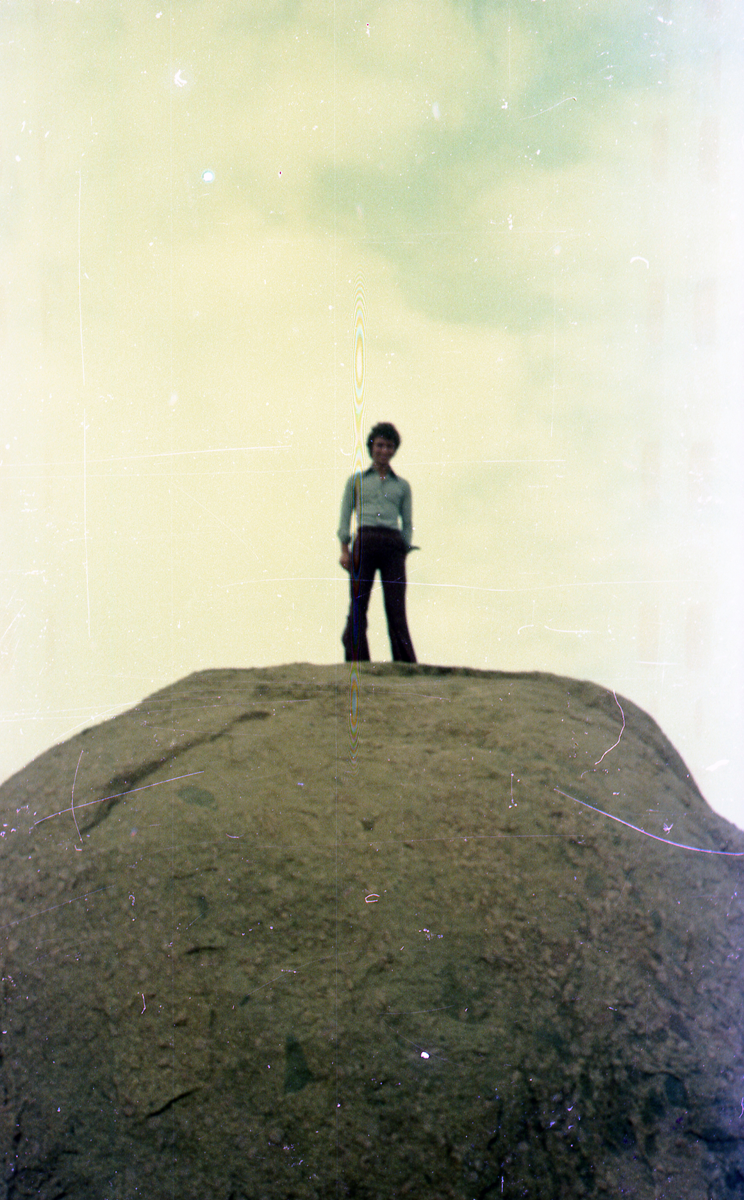
Cling, 2012
super 8 film transferred to video, color, sound, 2’46’’
Som: Christine Fowler
“Elegy for Dead Guitars"
hetero q.b.
This international programme of events showcases a group of video
works, made by women, which deal with themes ranging from feminism, to
lesbianism and transgender. The selection spans countries and realities
that are seen as ‘peripheral’ in relation to classic Euro-American
feminist discourses and practices – normally regarded as more
progressive defenders of the equality of women and of gender.
They are societies in which, in recent decades, historic, cultural,
social, political and natural tensions surrounding gender have been
played out according to different rules, challenging the very history of
the feminist movement.
This season also reveals some of the most significant debates in
relation to issues of feminisms or post-feminism, as well as the entire
range of queer diversity, from lesbianism, bisexuality, transexuality or
transgender, which has been fundamental in clarifying and constructing a
new culture and mentality with respect to these realities.
One such debate has been instigated by Judith Butler, whose
theorising of these issues from a historical perspective has recently
led to an advocacy of a rapprochement of the feminist and transgender
movements around a shared set of values, countering a latent conflict
between the many factions of sexual identity, in favour of a society
which reconfigures the distinctions between internal and external life,
rejecting the pathologising of cross-gender identification. For Butler,
the terms used to designate gender are historical categories and undergo
a continual process of reshaping, leaving room for other possible ways
of understanding them, since ‘sex’ and ‘anatomy’ are also subject to
cultural regulations and norms. ‘Masculine’ and ‘feminine’ are
constantly undergoing transformations, each one of those terms having
social histories which change radically according to geopolitical
borders and cultural obligations.
Another debate has opposed the hegemony of Euro-American feminist
discourse in black, Indian, Chinese and Arab cultures and countries,
denouncing the dichotomies inherent to ‘white’ feminist discourse as a
form of perpetuating the structural power relationships of the
capitalist system and asserting a Western approach of superiority over
the ‘other’. This is an area in which feminist discourse is being
rethought, enabling new forms of activism and theory. Specific studies
and works on black feminism, or feminism within Islam have been the
precursors to a new heterogeneous and decentralising approach to classic
feminist discourse. This new approach has much in common with the
reality of southern European countries, by encouraging a convergence of
debate and practice in spheres of action that contemplate facets such as
the intimate and the biographical, popular culture and customs, rather
than philosophical and theoretical discussion.
The aim of this season of events is not to construct a propagandistic
discourse on gender issues. It is however informed by the belief that
the heterosexual framework of contemporary society plays a normalising
and regulating role for patriarchal authority, and that its
implementation permits the existence of significant areas of inequality.
This is indeed demonstrated by the multiplicity of artistic approaches
which have developed in diverse social spheres over recent decades,
using various forms of expression to confront, condemn, reveal or simply
explore the complexity of gender and the way it is experienced.
Gender theory has been debated and questioned in numerous scientific
and intellectual spheres, however it has also entered the realm of
public debate, combining the examination and condemnation of the new
models of the experience of sexuality and the creation of a
corresponding legal and political framework.
The theme is still a taboo whose specifics have been little examined
in various societies, for various reasons. However a recent collection
of articles on the subject, published in the magazine Le Magazine
Littéraire posed a pertinent question, asking if we ‘should be scared of
gender or, on the contrary, should take advantage of the way that it
destabilises our normal ways of thinking in order to transform/better
our society.’ Gender is also a doctrine under construction, whose
boundaries of debate and investigation have in recent years expanded
exponentially, just as it has intervened divisively in the moral,
ethical and social organisation of contemporary societies, which alone
justifies our attention to the theme.
The programme of events we now present aims to contribute to an
understanding of the complexity of gender and the feminine, through
artistic and heterogeneous thought conducive to an awareness of equality
and tolerance.
Emília Tavares
Curator
Dear Emília
I am still in the grip of the ‘panopticon’ after our visit to the
exhibition at the Hospital Miguel Bombarda Museum. The area dedicated to
Valentim de Barros, the dancer and artist who lived in the Secure
Pavilion for more than 40 years, both disturbed and inspired me, in
equal measure, in its revelation of the art and the suffering of a life
regulated by the prison hospital. The exhibition included two black and
white photographs of Valentim, enacting two scenes for the camera that
somehow define what his everyday life must have been like in the cell,
that tiny space of just a few square metres, which we were also able to
visit.
In one of these photos he is at the door of his cell, looking at us
like a host offering an ambiguous invitation to cross the threshold of
his domesticity, simulating the utopia of a homely day-to-day existence
which is clearly made impossible by his containment by the institutional
regulations of the prison. Our eyes meet in this examination of what
the everyday life of an artist living under the normative vigilance of
the architectural panopticon might be like. In another photo, his gaze
is turned away from us, as he works with concentration on some
embroidery, one of his daily artistic activities, alongside the creation
of rag dolls and painting. During this moment of creativity, his gaze
no longer confronts us but invites us to join him in his concentration
on this task that formed the focus of his daily work.
In one of the three paintings by Barros shown in this exhibition,
there is a scene which typifies his fantastic pop style: a landscape in
ice cream colours, along a road punctuated by the whites and pinks of
flowering trees and a castle worthy of Disneyland, where two figures in
female clothing, in high-necked tops, colourful miniskirts and white
knee socks are intertwined in an embrace directly in front of our gaze,
while their faces, cheek to cheek, are undefined, uncanny, neither
obviously girls or boys, children or adults, the smile on their lips
belied by the emptiness of their black eyes, suggesting bodies in a
state of becoming, of potentially queer and queerising transgression.
We called this project hetero q.b. based on the premise that
sexualities are an essential component of artistic work and the power
relations which are established between artists and institutions. The
arts in Portugal area are a space undergoing change, negotiable and
flexible... up to a point, after which it becomes more difficult, if not
impossible, to infiltrate it with projects which challenge, which go
beyond the rules of heteronormativity. Exceptions may at times find
their way through to the art world but heteronormativity is still seen
as the rule. Heterosexuality acts as the normative filter – hence the
title: hetero quanto baste (q.b.) [hetero in due measure]. But also the
counterproposal you suggested in your text: hetero (geneity) q.b., in
the museum as in life.
Though it might seem strange to use the word hetero (q.b.) as the
title of a project which brings together videos made by women, and a gay
artist such as Valentim de Barros, this allusion serves to emphasise
the queer perspective within the representations of genders and
sexualities that we showcase in this project.
The working methodology we have adopted, characterised by
interdisciplinary combinations designed to reposition the link between
artistic production and the question of gender and sexuality, is similar
to that proposed by Lisa L. Moore in the book Sister arts: the erotics
of lesbian landscapes (2011). In the book, the author uses a poem by
naturalist philosopher Erasmus Darwin to show the way that lesbian
landscape art, practised by Mary Delany, artist and inventor of the
botanical collage, and Margaret Bentinck, collector and patron of
science and the arts, was feted by the artistic community that gathered
around them in the eighteenth century.
However, their use of the language of flowers and of the garden to
express intimacy and love between women was invisible within art history
and it is only through a more cross-disciplinary, queer, methodology,
combining gossip, rumours, secrets, intuitions, passions and friendships
with archival research and the use of cultural and aesthetic objects,
that it becomes possible to access an account of history that is still
to be made. This was the approach that we took in our programme, using a
combination of critical theory, biographical narrative, archival
research with cafe conversation and the sharing of secrets to map out a
territory which is still not defined. We could have followed a more
orthodox approach, along more conventional feminist lines, but the queer
methodology that we adopted reflects that of the artists whose works we
have selected.
In addition to the use of queer methodologies in their
conceptualisation, the video works in the programme have another common
feature: they do not shun involvement with the heteronormative
masculinity of patriarchal society, which has been questioned by
feminist theories and practices. Instead, they exhibit a creative
exploration of the myths and fantasies that surround masculinity,
demonstrating the need for a playful, physical and at times monstrous
engagement with normative masculinity and machismo in order to recognise
queer female masculinities.
In her study Female masculinity (1998), Judith Halberstam sustains
that ‘female masculinity’, masculinity without men represented, for
example, by masculine women or boyish young girls (so-called ‘tomboys’),
far from being a simple imitation of the masculine, offers us an
insight into the way that normative masculinity itself is constructed:
‘female masculinities are framed as the rejected scraps of dominant
masculinity in order that male masculinity may appear to be the real
thing. But what we understand as heroic masculinity has been produced by
and across both male and female bodies’.
What are the hetero or alternative masculinities in this programme?
How are genders, feminisms and power intertwined within art? What is the
impact of regarding art as heterosexual, homosexual or in any other way
sexual? It is a question of outlining strategies of (de)normalisation
used by artists in their work, queer experimental perspectives that defy
the established categories of gender and ethnicity/race. In this
spirit, the legacy of Valentim de Barros, as an extreme example of the
‘outsider artist’ condemned to the psychiatric environment (from
dictatorship to democracy) more as a result of his perceived gender
aberration than for an obvious mental disorder, creates a context for
receiving a queer art that is invisible in Portugal, emerging from the
meeting of obsolete and discriminatory institutional practices with
liberating international embraces.
paula roush
Curator
Exhibition Credits
Curators: Emília Tavares & paula roush
Text: Emília Tavares & paula roush
Edition and design: Barbara Says…
Technical support and instalation: António Rasteiro
Sponsorship : Rita Sá Marques
Communication: Rita Sá Marques
Traduction: Kennistranslation
ARTIST'S LIST
Ana Bezelga, Ana Pérez-Quiroga e Patrícia Guerreiro, Ana Pissarra,
Carla Cruz, Catarina Saraiva, Célia Domingues, Cristina
Regadas, Elisabetta di Sopra, Hong Yane Wang, Itziar Okariz, Joana
Bastos, Lilibeth Cuenca Rasmussen, Maimuna Adam, Mare Tralla, Maria
Kheirkhah, Maria Lusitano, Mónica de Miranda, Nilbar Güres, Nisrine
Boukhari, Oreet Ashery, Patrícia Guerreiro, paula roush & Maria
Lusitano, Pushpamala N, Rachel Korman, Razan Akramaw, Rita GT, Roberta
Lima, Sükran Moral, Susana Mendes Silva, Tejal Shah, Zanele Muholi.
http://www.museudochiado-ipmuseus.pt/en/node/1449